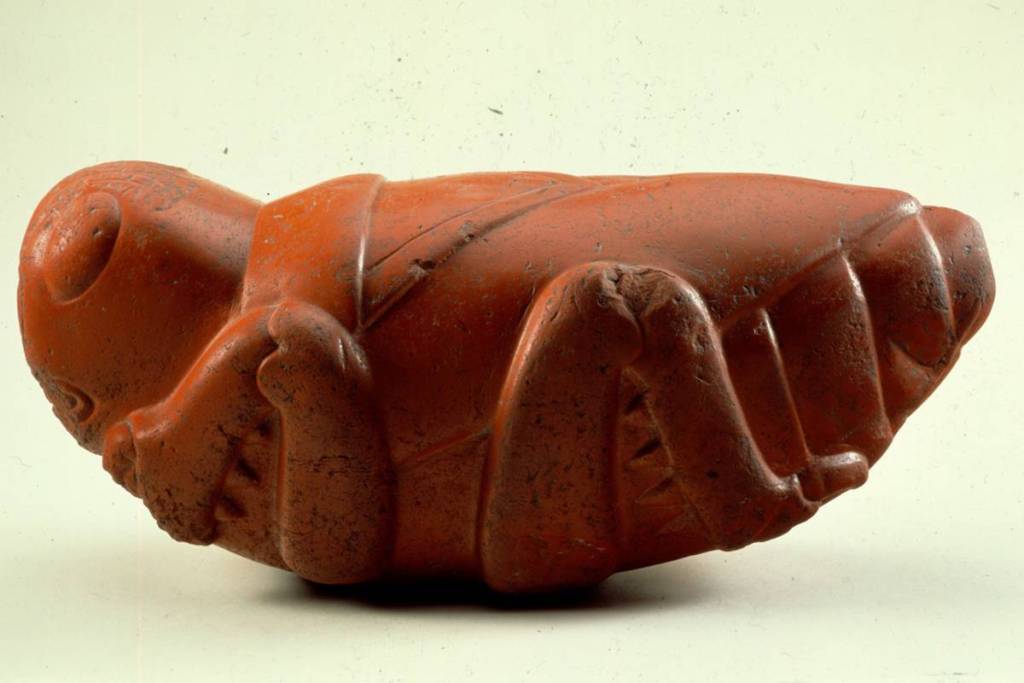
Have you ever wondered what hidden treasures lie deep within our city’s most iconic forest? Amid its springs and centuries-old legends lies the story of the coral-red grasshopper found in Chapultepec Forest, an astonishing monolithic sculpture dating to the Late Postclassic period (1325–1521 AD) that captivates with its intense red color and flawless craftsmanship. Get comfortable and get ready to learn its story!
According to archaeologist Leonardo López Luján, in his article El chapulín colorado de Chapultepec for the magazine *Arqueología Mexicana*, the piece measures 16 x 19.5 x 47 cm and represents a true aesthetic masterpiece attributed to the Mexica or Tepanec cultures.
When and where was the piece actually found?
In reality, there is no official date for the discovery of this piece. Chapultepec Forest, via social media, confirmed that this piece was found in 1891; however, archaeologist López Luján asserts that W.W. Blake’s 1891 catalog merely compiled earlier accounts, noting that the figure had already been in private collections half a century earlier, and even mentioned that it was unearthed on the hill during construction work on Chapultepec Castle around 1785.
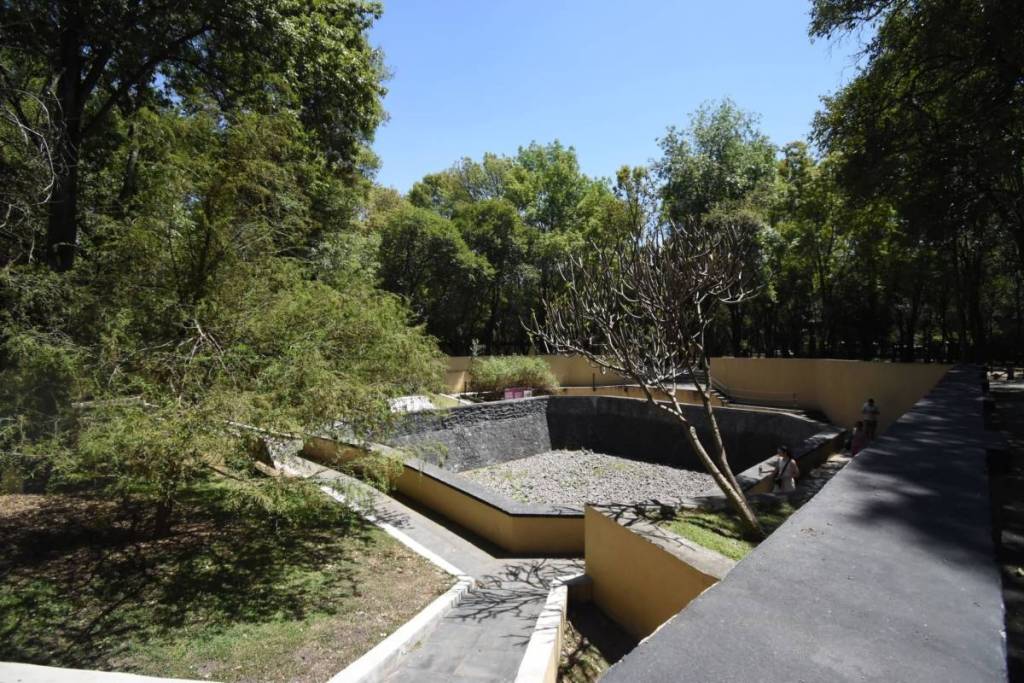
An anonymous handwritten document, preserved in the Historical Archive of the National Library of Anthropology and History (BNAH), states verbatim that the sculpture was “taken from the alverca of Chapultepec, which belongs to the H.da de la Teja, which belonged to the aforementioned Count [del Peñasco].” As the archaeologist explains, this suggests that it was found in the so-called “alberca grande,” also popularly known as the “Baños de Moctezuma” (located about 300 meters south of the Castle), which was part of the estate of José Mariano Sánchez Mora and was remodeled in the 19th century.
López Luján notes that Blake drew on various details from earlier writings and that his statement regarding the summit remains enigmatic. Consequently, archaeological and documentary evidence points more strongly to the area of the pools and springs at the foot of the hill (linked to the cult of water and Ehécatl), although both versions coexist in the viceregal records.
From the viceregal cabinet to the National Museum
According to documentary research by *Arqueología Mexicana*, the oldest known depiction dates back to 1828, when the Rhineland artist Maximilian Franck sketched the grasshopper from the private collection of José Mariano Sánchez Mora, third Count of Peñasco and former aide-de-camp to Agustín de Iturbide.
Later, in 1841, the diplomat Brantz Mayer examined it and described it in his letters as a polished stone idol that was venerated in the capital. Upon the count’s death, the entire collection became part of the National Museum’s holdings and is currently on display in the Mexica Hall of the National Museum of Anthropology.
Anatomy, Worship, and the Power of the Wind
Although it is popularly known for its agate- or carnelian-like material, with a hardness of 7 on the Mohs scale, entomologist Moisés Herrera determined that the sculpture does not depict an adult specimen, but rather the larval stage of a grasshopper from the Acrididae family, featuring large compound eyes, diverging antennae, and four folded legs.
For pre-Hispanic cultures, these insects were part of the fauna associated with Ehécatl, symbolically linked to the breath of the wind, the fertility of the rains, and the ripening of the crops.
Beyond its streets, architectural gems, and museums, Mexico City has a fascinating past waiting to be discovered. Engage all your senses to continue learning about the unique features and interesting facts that are part of our city—and, of course, head to the Museum of Anthropology to see up close the coraline grasshopper found in Chapultepec Forest.