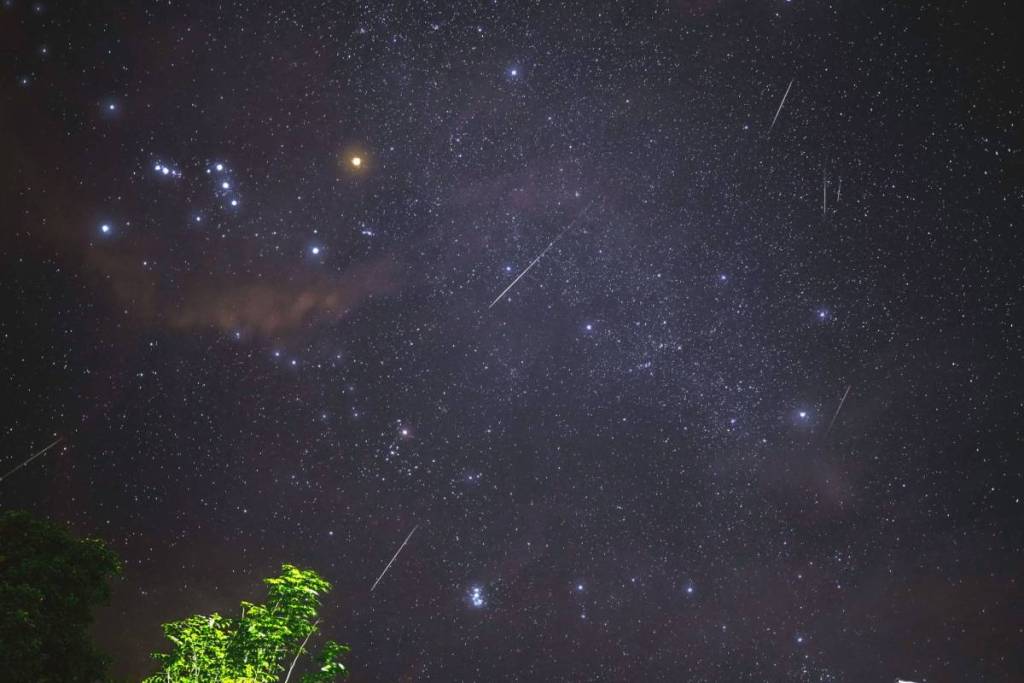

Do you love gazing at the sky in search of shooting stars? Then get ready, because from October 6 to 10, there will be a Draconid meteor shower. Best of all, the sky will provide the ideal conditions for enjoying this astronomical spectacle.
The best view occurs just at dusk, when its radiant—located in the constellation Draco, close to the stars Eltanin and Rastaban—is still high in the northern hemisphere sky. Peak activity will occur between 8:00 p.m. on October 8 and 3:00 a.m. on October 9.
According to the National Geographic Institute, we can expect to see an estimated 20 meteors per hour. As a fun fact, these meteors are notable for being slow, leaving very delicate trails that last a little longer.
Where does all this visual magic come from? The main culprit is Comet 21P/Giacobini-Zinner, a space traveler that orbits the Sun every 6.6 years. As it travels, it leaves behind a trail of dust that Earth passes through every year. And although it surprised us with storms of thousands of meteors in 1933 and 1946, no massive outbursts are expected in 2026.
Some tips for viewing the Draconid meteor shower
The good news is that you don’t need a telescope. You just need to find a dark spot and look up toward the highest part of the sky.
According to data from the Star Walk website, you can also take the opportunity to catch a glimpse of Saturn, the Andromeda Galaxy (M31), and the Pleiades star cluster (M45), which will be visible that same night.
In short: find a quiet spot away from city lights, put on comfortable clothes, and arm yourself with a little patience. The Draconid meteor shower has everything ready to treat you to a super-relaxing and truly unforgettable night under the stars.