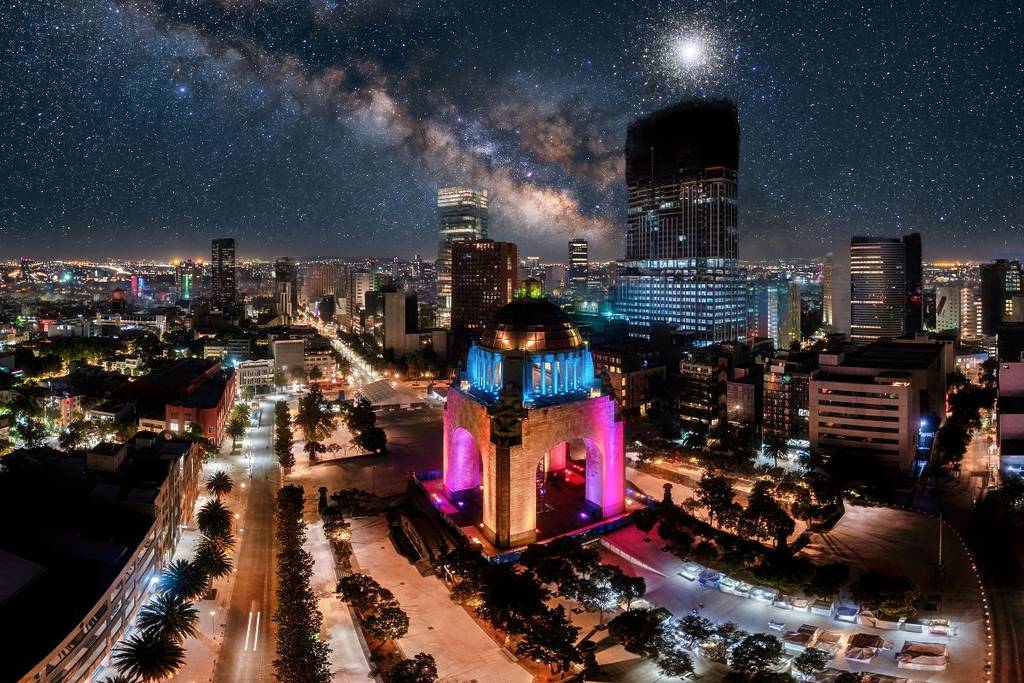

The night sky in May will feature one of the most impressive astronomical events of the year. This Monday, May 18, the famous M13, better known as the Hercules Cluster, will be visible—a gigantic collection of stars considered one of the brightest and most spectacular objects visible from Earth.
This globular cluster is located in the constellation Hercules and contains hundreds of thousands of ancient stars held together by gravity. According to data from NASA and ESA, M13 is approximately 22,000 light-years from our planet and contains between 300,000 and 500,000 stars.
Although it was discovered in 1714 by astronomer Edmond Halley, it remains a favorite among those who enjoy stargazing. The best part is that you don’t need professional equipment to see it.
How can you see the Hercules Cluster from Mexico City?
The best time to observe it will be after 10:00 p.m. on May 18. Astronomers recommend first locating the stars Vega and Arcturus, as the constellation Hercules lies between them.
It will be possible to see it in Mexico City, although light pollution may make the experience a bit difficult. Therefore, it’s best to look for areas with fewer lights, such as the southern part of the city or open spaces away from the center.
To better enjoy this astronomical phenomenon, we recommend:
- Use 10×50 binoculars or small telescopes
- Wait at least 20 minutes for your eyes to adjust to the darkness
- Check that the sky is clear
- Use astronomy apps to locate the constellation
To the naked eye, M13 may appear as a small luminous spot, but with binoculars or a telescope, it is possible to make out part of its enormous concentration of stars.
A key object for understanding the universe
In addition to being visually stunning, the Hercules Cluster is also important to science. Its stars are more than 11 billion years old, which helps researchers study the early stages of the Milky Way.
Even in 1974, the Arecibo radio telescope sent a famous message into space directed toward M13 as a possible attempt at extraterrestrial contact. Since then, this cluster has become even more famous among astronomy enthusiasts.
📍 May 18, 2026
⏰ Starting at 10:00 p.m.