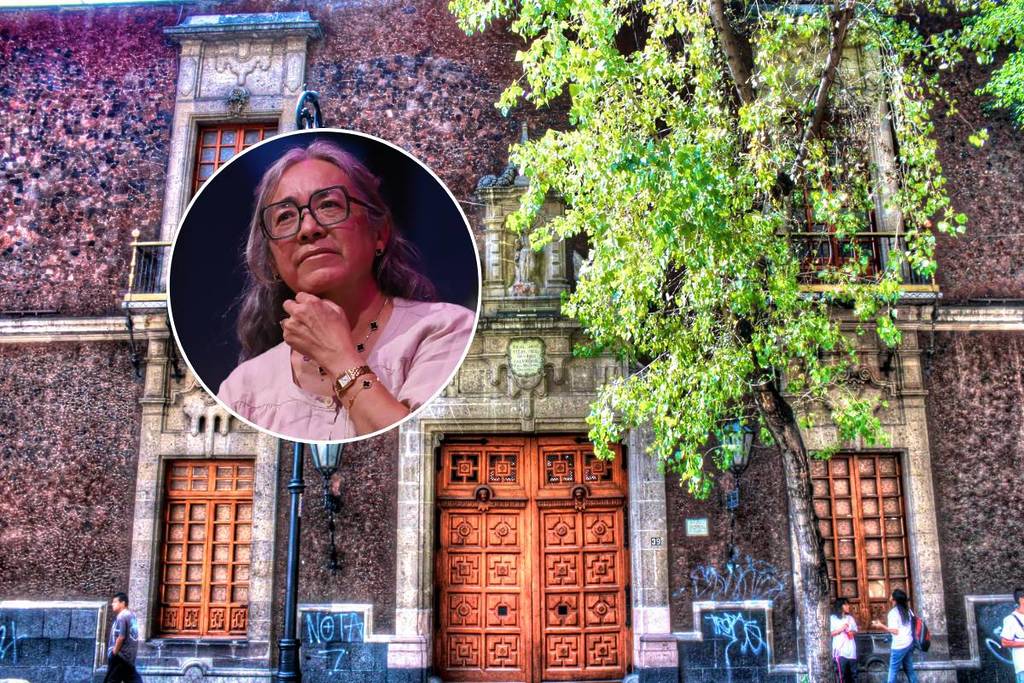
Among the old bookstores and old buildings of Donceles, there is an old place with scary faces on its door. What many don’t know is that it was the Hospital de las Mujeres Dementes and appears in Cristina Rivera Garza‘s novel.
The next time you walk down the emblematic street of the Historic Center that seems to have been frozen in time, stop to observe this spot because it holds great stories.
This is the story of the old hospital in CDMX that appears in Cristina Rivera Garza’s novel.
In her book “Nadie me verá llorar”, Cristina Rivera Garza reminds us of a building that has existed for centuries: the Hospital Divino Salvador.
This place to which the author refers in her novel was a psychiatric hospital for women (it was also known as Hospital de las Mujeres Dementes).
The Jesuit congregation El Divino Salvador founded this hospital in 1700 at Donceles 39, when the street was known as Canoa. It received hundreds of mentally ill women, from children to adults.
There they applied hot and cold water baths for the treatment of insanity, according to historian Guadalupe Villa Guerrero in “El Hospital Divino Salvador para mujeres dementes”.
Many decades have passed through this building. During the Mexican Revolution, it functioned as a barracks and is currently an Institutional Documentation Center with only 20% preservation of the original construction, according to the Official Visitors Guide of the CDMX of the capital’s government.
This is how it inspired the pages of “Nadie me verá llorar” by the Mexican writer
In addition to centuries of history, this building in Donceles has become popular for the shadowy figures of faces that can still be seen on the main door, with gestures of fear and sadness.
Author Cristina Rivera Garza revisited the hospital for her novel “Nadie me verá llorar”, set in the 20th century, which tells the story of a photographer who immerses himself in a psychiatric hospital.
In his story, Rivera Garza tells in an excerpt that mentally ill women escaped from that place to wander in the crowds of the Centro Histórico. Many of them went out to beg for alms and returned to the psychiatric hospital out of fear of the outside world.
Nowadays, the building is one of the oldest architectures of the Centro Histórico that stands among bookstores, camera stores and coffee shops, so the next time you walk by, don’t forget to visit this place that exists in fiction and reality.