
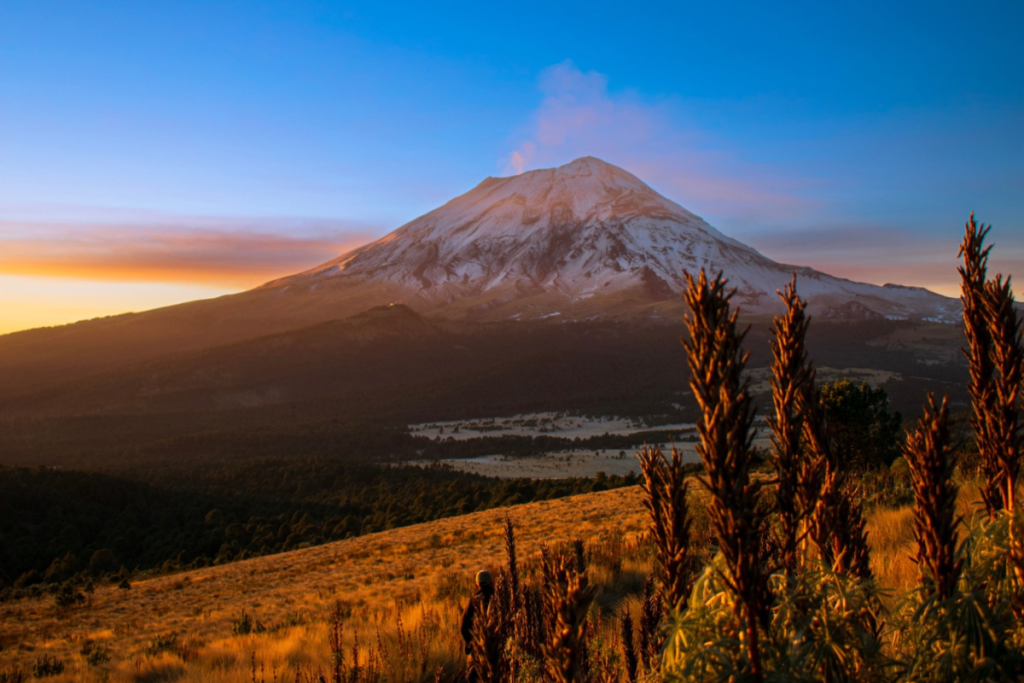

Goodbye to Paso de Cortés! The iconic spot between Popocatépetl and Iztaccíhuatl has a new name
If you love hiking and nature getaways near Mexico City, you’ve surely heard of Paso de Cortés on more than one occasion. Well, it turns out that this iconic spot—where you can enjoy breathtaking views of our volcanoes—has a new name: Paso del Águila.
Recommended Articles
 Will it snow in Mexico City this weekend? Here are the areas where snow could fall with the first winter storm
 It beat out the Prado! The National Museum of Anthropology is the best in the world in 2026, according to Worth a Journey
The state legislatures of Puebla and the State of Mexico approved the name change on October 29. However, it was not until November 25 that the new name took effect in the State of Mexico.
This change has an interesting history behind it that takes us back to pre-Hispanic times, long before the arrival of the Spanish.
Why is Paso de Cortés now called Paso del Águila?
Did you know that this path through the volcanoes was already used by Indigenous peoples before the Conquest?
According to the National Commission for Protected Natural Areas (Conanp), this site was formerly known as Tlamacaxco, which means “Upper Pass.”
It was in 1519 that Hernán Cortés crossed this mountainous corridor and gazed upon the Valley of Anáhuac for the first time—an event to which the name by which we’ve known it for generations is owed.
The new name is inspired by another of its historical references: Cuauhíchcac, which means “the eagle’s cleft.”
In addition to recognizing the region’s Indigenous history, the change aims to highlight the importance of the birds that inhabit these mountainous ecosystems.
Even textbooks might change!
Located within the Iztaccíhuatl-Popocatépetl National Park, this area spans the municipalities of Amecameca and Atlautla in the State of Mexico, and San Nicolás de los Ranchos in Puebla.
Although its new name is now official in both states, we may still come across signs and maps that refer to Paso de Cortés.
In the State of Mexico, there is a period of up to 180 calendar days to update official references. Educational authorities have even been asked to incorporate the new name into free textbooks.
That said, the name change does not alter the territorial boundaries or establish new conditions for visiting this natural spot.
For now, the CONANP website itself continues to refer to the site as Paso de Cortés, so both names may coexist for the next few months.
