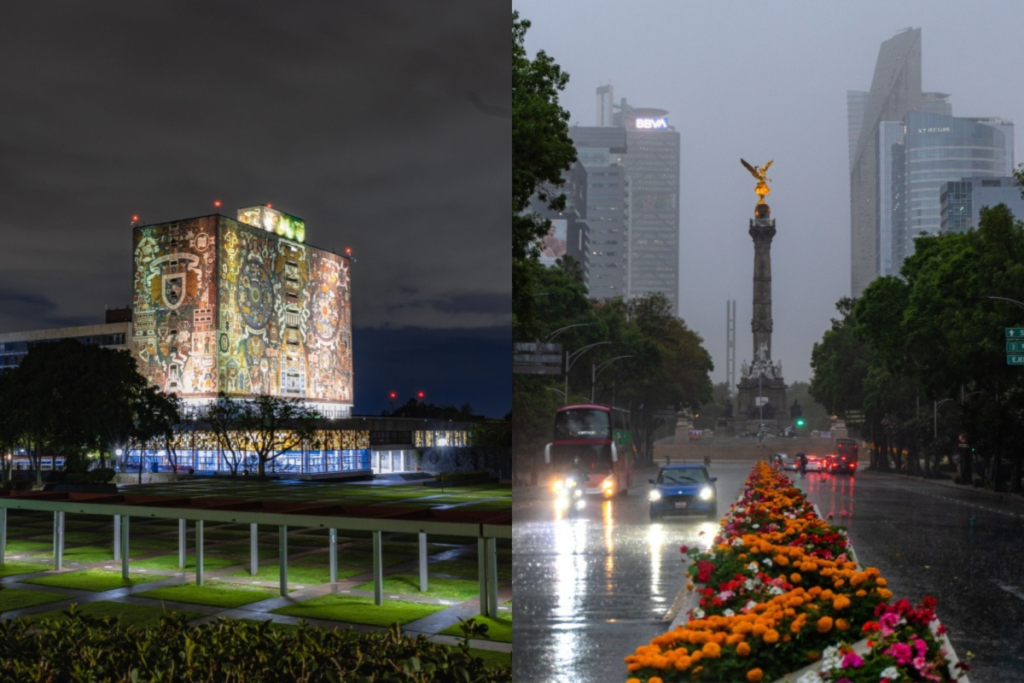

Have you ever been in one part of Mexico City where it’s pouring rain, but when you get to another part, you find the streets completely dry? Although it may seem strange, there’s a scientific explanation for this phenomenon. In fact, it rains nearly 40% more in Ciudad Universitaria than in the Mexico City International Airport area, according to a researcher at UNAM.
This curious fact was shared by Víctor Magaña, a specialist at UNAM’s Institute of Geography, in a June 17, 2025, UNAM Global publication.
And no, it’s not simply that clouds prefer the southern part of the city. The explanation has to do with winds, cloud formation, and even the heat generated by our own city.
Why does it rain more at CU than at the Mexico City International Airport?
According to Víctor Magaña, prevailing winds can carry clouds from the northeast of the Valley of Mexico, near Teotihuacán, toward areas such as Coyoacán, Tlalpan, Xochimilco, and the western part of the city.
During that journey, the clouds can grow and intensify, causing them to release varying amounts of water depending on the area they pass through.
The researcher explains that a cloud can measure approximately five kilometers in diameter, while the metropolitan area spans a much larger territory. For this reason, a single storm does not necessarily bring rain to the entire city, nor does it do so with the same intensity.
This dynamic helps explain why CU can record nearly 40% more rainfall than the area surrounding the airport, located in the Venustiano Carranza borough.
Mexico City’s heat also influences rainfall!
Another interesting fact is that urbanization can alter rainfall patterns.
According to UNAM, concrete, asphalt, and a lack of vegetation contribute to the formation of heat islands, which raise the temperature of certain urban surfaces.
This warming can stimulate cloud growth and promote convective rainfall, which is characterized by localized downpours that are sometimes very intense.
So the next time you see heavy rain in Coyoacán while other boroughs remain dry, remember that the climate of our beautiful Mexico City depends on various factors that can vary even between neighboring neighborhoods.